 |
| Yonex R7 with original Yonex racquet bag from early 1980s |
Sunday, 1 November 2015
Yonex R7

Wilson Hammer 6.2 Stretch (aka 'The Skunk')
 |
| The distinctive black and white paint job of 'The Skunk' |
Yamaha Silver 90
 |
| The Yamaha Silver 90, with sliding side bars so head weighting can be altered |
These are ceramic frames, which I normally do not go for since I find ceramics a bit toothless ususally. However, what makes these frames notable is the way you can alter the weight/head balance by moving plastic sliding panels on either side of the frame in order to generate more spin or more plough. I am suprised this very innovative idea never caught on, but I imagine the patent was lost when Yamaha exited the tennis scene. Maybe it is time to resurrect this idea...come on Wilson, give Yamaha a break and either buy the patent off them or allow Yamaha to re-enter the racquet market.
 |
| by moving the slide panel, head balance can be altered |
Prince Graphite
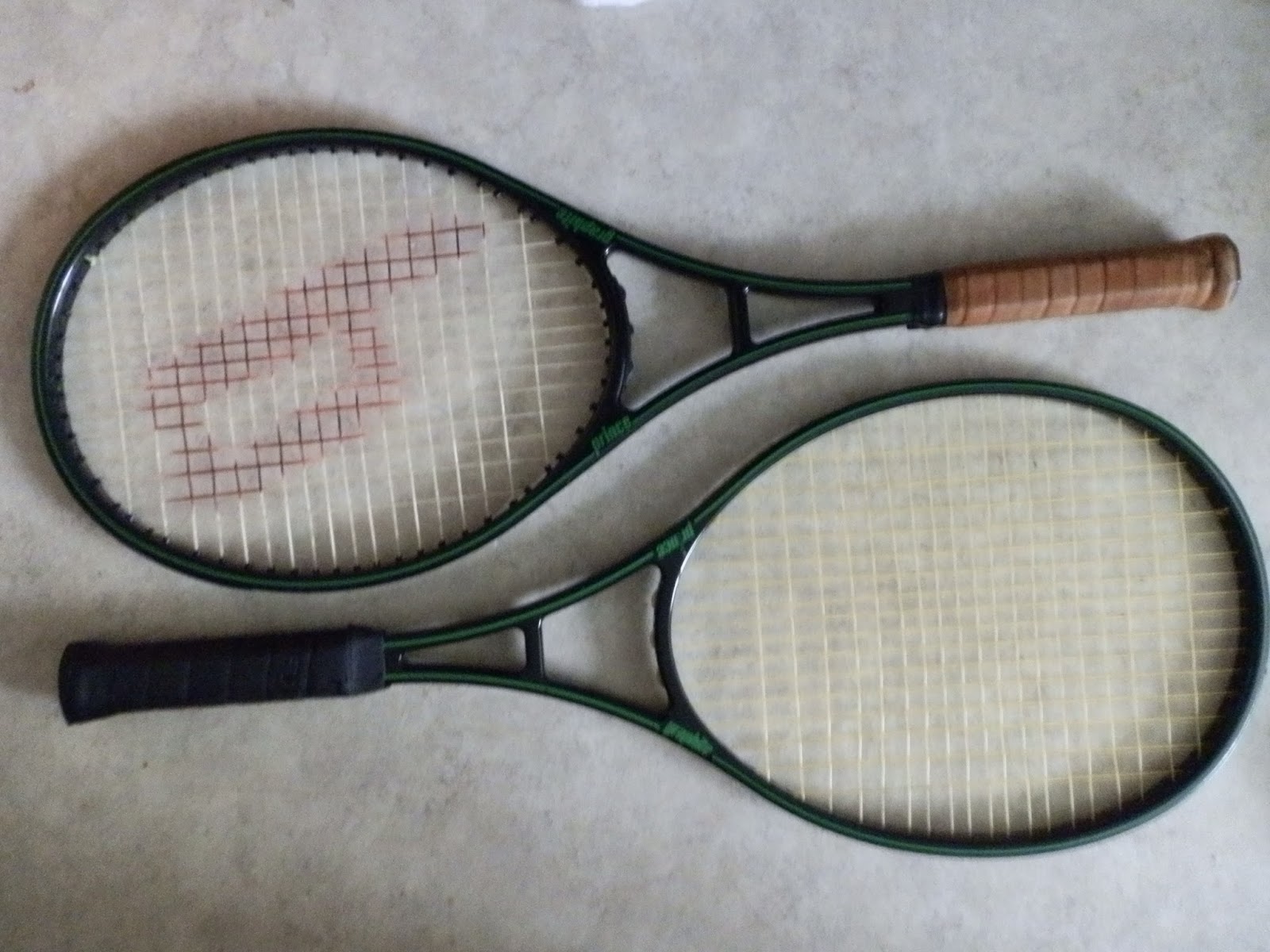 |
| The Prince Graphite 90 Series and original Prince Graphite (110) |
Dunlop Max 150g and Dunlop Max 200g
 |
| Dunlop Max range : the 150g (top) and 200g (forever to be associated with McEnroe and Graf) |
The Dunlop Max 200g is, of course, a well known classic used by The Mac and Steffi Graf. Hard to know what to say about this stick that hasn't been said. It has a nice smooth feel, generates good plough through and can still give modern frames a run for their money. That said, both these rackets are heavy for serving. But when one considers they were up against rival wooden frames there is just no contest. Ironic that McEnroe championed the era of graphite sticks but nowadays he often laments the passing of wood and the rise of power tennis over spin and guile that the players of eras past displayed.I didn't notice him complaining when his ground breaking Max 200g was crushing his more traditionalist wooden frame wielding opponents!
Monday, 6 July 2015
Yamaha's Hi-Flex Lite and Hi-Flex Super Lite
 |
| The excellent Hi-Flex Lite from Yamaha |
offer excellent arm friendly play and also give good control. The Yamaha Hi-Flex Lite is a personal favourite. Despite the rather plain paintjob, this racket really sparkles on court. Flexible frames need to be strung at a fairly high tension, in my view, for the frame to really bend and snap back when ploughing through the ball. This one is not has high as I would like, but is sufficiently tight to really 'Feel The Difference', as Yamaha's rhetoric goes. Unfortunately, the Superlite (see below) needs a restring because the tension is far too low for anything to flex except the strings themselves. However, I fully expect it to perform well once this is done. These rackets are light, evenly balanced sticks that make me wish Yamaha still made ones like them!
 |
| In need of a restring, but the Hi-Flex Super Lite is one I really look forward to using soon. |
Saturday, 4 July 2015
Yamaha EOS (Efficiency of Swingweight) and Yamaha EOS RZ
 |
| Yamaha EOS with weight distributed towards top of the frame to promote swingability |
The EOS is a lightweight frame with nice flex, but certainly not as flexy as other sticks of theirs I have tried. Importantly, these EOS frames can still hold their own against modern rackets, which is one of the reasons I love Yamaha so much. Pictured above is the 100 sq. inch EOS model in sandal brown...and below is the EOS RZ, with the slightly larger 110 sq.inch frame and the much
nicer paint job, don't you think?
 |
| a 1990s classic - powerful and light! |
Yamaha Secret 04
 |
| the legendary Yamaha Secret 04 |
 |
| strange signature style Mr Noah! |
Thursday, 14 May 2015
Coming this summer!
 |
| coming to classic racquets soon! |
A lot of 'new' classic racquets are waiting in the wings to be uploaded this summer...these include the following:
Wilson Pro Staff Classic 6.1
Pro Kennex Shadow 90
Prince CTS Lightning
and many more....
For neat pics and insightful comments please drop in to www.classicracquets.blogspot.com !
Sunday, 15 March 2015
Fox Bosworth Tournament
 |
| My all-time favourite stick, the Fox Bosworth Tournament: flexible frame, dense string pattern, tapered handle - just awesome! |
For those that don't know, Fox were an American racquet manufacturer who teamed up with Warren Bosworth, a professional racquet technician and innovator who worked with some of the sport's greats! He is possibly best known for being Ivan Lendl's personal racquet stringer in the 1980s.The story goes that Lendl needed rackets restrung and dispatched to him asap.He rang Bosworth up late one night but when asked for the stringing tension Lendl was not sure. So Bosworth set up a tape recorder and got Lendl to give the string tension tone of his existing match racket over the phone. Using this he was able to string up Lendl's new racquets to perfection. But Bosworth is also a master of experimentation with racquet materials and shapes and in this regard Fox signed him up to develop their Professional and Signature Series sticks.
 |
| the tapered handle that makes this racquet uniquely comfortable and spin friendly |
The one here has a dense string pattern (18 x 20) that allows for a lot of control.It is also head light, which promotes good spin. But the standout feature of this model is the unique grip shape, which is tapered to fit easily and smoothly into the hand. It allows for extremely wristy shots and is paricularly helpful for imparting extra slice and spin because you can really snap your wrist sharply as you execute the shot. In my view, all racquet handles should be made like this but I imagine Bosworth owns the patent.It is the ONLY racquet I have ever seen with this feature and is why I love this stick so much. Added to which, this is a very flexible frame that holds the ball as you hit it for a milisecond and is arm friendly too. All in all, and pound for pound (well, gram for gram/ounce for ounce) this is my fave racquet of all time....and I have used quite a few!
Originally, I came across my beloved Fox Bosworth Tournament in a charity shop for around 3 GBP and this seemed a gamble as I had never heard of Fox or Warren Bosworth at this time. But I am SO glad I bought it. I have used a lot of flexible frames, in particular Yonex frames (RD series, RQ, RDS) and also some other Fox Bosworth frames too - but none of these even come close to the flex and control I get with my Fox Bosworth Tournament.I especially enjoy using it to win against players using expensive modern frames, who often ask me what brand I am using. This really is an undiscovered classic in this reviewer's opinion!
I have tried to find more examples of this stick on online auction sites but despite finding lots of Fox Bosworth sticks, never this one! I would love to buy a spare frame, so if anyone has one to sell or will possibly swap with me for one of my other sticks, please get in touch!
Sunday, 11 January 2015
Donnay Graphite Plus 35

Donnay produced this one in the early 1980s and was apparently used by Chip Hooper - but this name is a bit before my time. The design reveals that Donnay were still in the early days of moving away from wood. But this stick would have offered a flexible option back then. The number 35 appears to relate to head size. Donnay made a 25, 35 and 50 plus stick with the head size 25%, 35% and 50% larger than standard respectively. However, if I am wrong about this and the number does relate to flex, then let me know.
Fischer Match Maker (1&2)
 |
| the fairly rare Fischer Match Maker 1 and rarer Match Maker 2 |
I don't have specs for these sticks but in terms of head size think of your classic wooden racquet. May give these a try soon, though for serving one will need a strong arm and wrist. They do feel very inflexible to me also, but one link on Tennis Warehouse suggests they were designed to mimic the feel of wood. Hard to believe on current evidence.
Sunday, 9 November 2014
Yamaha Hi Flex Special
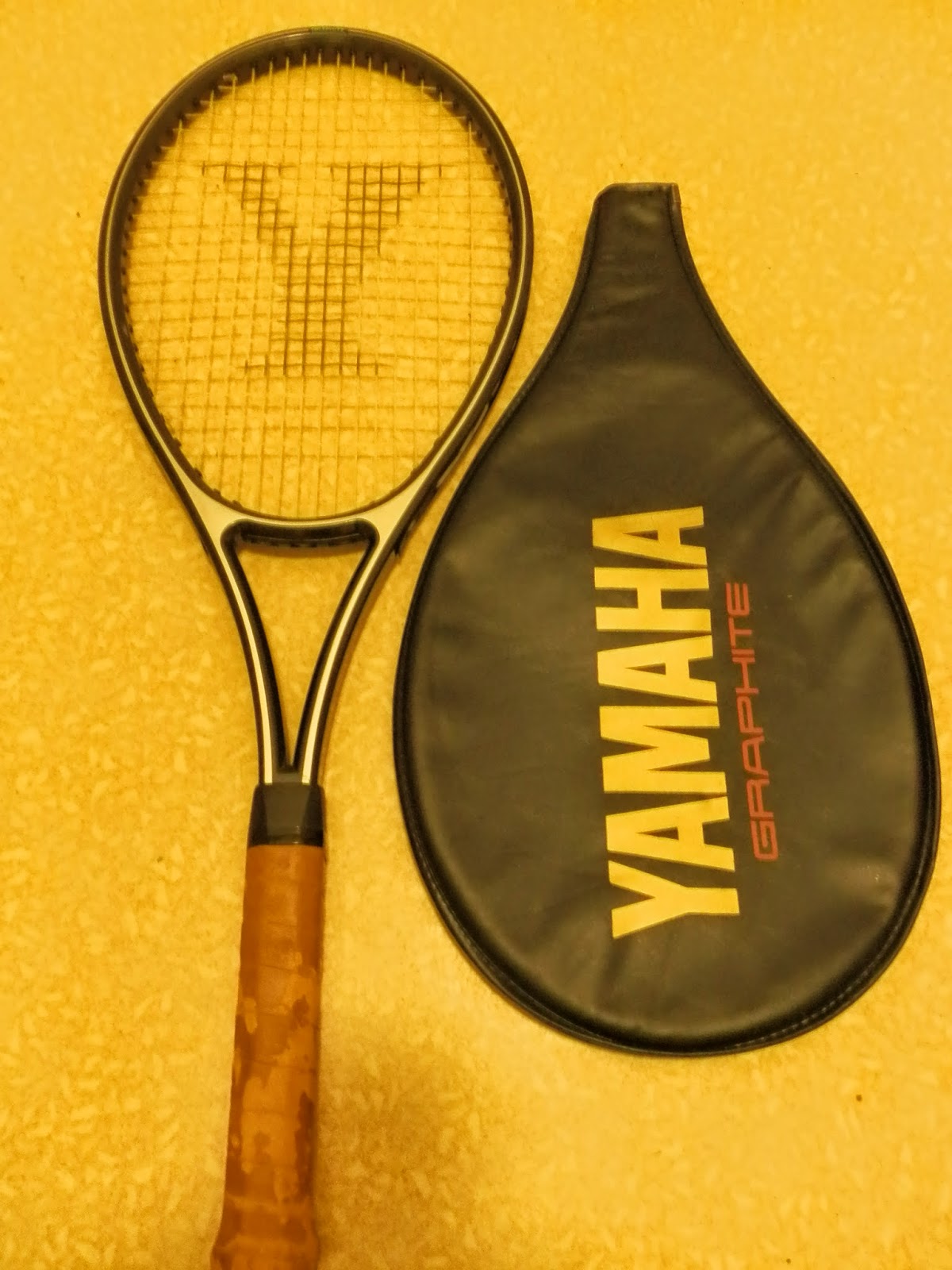 |
| a little known classic - the Yamaha Hi Flex |
This, in my view, is something of an undiscovered classic stick that I
picked up from a recycling centre recently. From the lush padded case
(these little things add to a racket too), to the neat silver finish,
this racket just told me to buy it. But the real clincher was the fact
that I love flexible frames and the name of this racquet promised all
the benefits of an arm-friendly experience with the wonderful hitting
experience you can get from a frame that bends with the ball. Anyone who loves
flexi frames knows what I am talking about - that sensation of bend and
release that comes when you connect sweetly with a hit and also the
sense of suspended time as the ball is held by the racket for a split
second. So, I was excited to try it, though not expecting too much
since Yamaha are hardly a manufacturer people usually rave about. But straight away this racquet gave me what I wanted. It bends so sweetly when you strike the ball cleanly.

It has a 90 sq. inch head (approximately) but despite this the sweet spot seems generous. The spin it gives me is considerable and this allows me to put more power into my shots without hitting long. All in all a wonderful racket and one that is now right up there among my very favourite racquets. If anyone knows anything about the Yamaha Hi Flex range (I know there is a Hi Flex 3 and 9 respectively, for instance) then please leave a comment.
Sunday, 10 August 2014
Pro Staff 6.1 Classic (Tour Edition)

Wilson T2000

The stringing is also interesting, with the strings attached to the frame by wire grommets. I have never really used these. The heads are incredibly small - much less than 90 sq. inches (possibly 63 sq. inches ). To use one you would need to be extremely accurate and have great technique. But they offer a fascinating glimpse into the tennis history.
Wilon Pro Staff 110 (large head version)

Snauwaert Ergonom

Snauwaert Hi-Ten 30

The Snauwaert Hi-Ten 30 is one I picked up from a charity shop/thrift store for a few pounds, so imagine my surprise when I I found the same racket priced on eb** for quite a bit more. Snauwaert's innovative reputation is demonstrated here by the extraordinary 12 x 13 stringing pattern. The large space between strings means this racquet can generate considerable bite and put heavy spin on a ball. The strings too are incredibly thick. I have not used this one much - it is more of a talking point in my collection than a stick I use. Plus, I am not sure that if a string broke I could find replacement gut of the same gauge for it. The Hi-Ten was one of a number in the Hi-Ten range that were notable for their spin potential. Definitely the most collectable of the sticks in this collection.
 |
| The thick gauge of string that features on the Snauwaert Hi-Ten 30 racket |
Saturday, 5 July 2014
Yonex RX-32

Yonex Rexking 22
 |
| The R-22 made famous by Martina Navratilova |
sweetspot for its head size. Looking forward to using this one over the summer.
 |
| 80s advert for the Yonex R-22 |
Subscribe to:
Posts (Atom)