Sunday, 11 January 2015

Donnay Graphite Plus 35

Donnay produced this one in the early 1980s and was apparently used by Chip Hooper - but this name is a bit before my time.  The design reveals that Donnay were still in the early days of moving away from wood.  But this stick would have offered a flexible option back then.  The number 35 appears to relate to head size.  Donnay made a 25, 35 and 50 plus stick with the head size 25%, 35% and 50% larger than standard respectively.  However, if I am wrong about this and the number does relate to flex, then let me know.


Fischer Match Maker (1&2)


the fairly rare Fischer Match Maker 1 and rarer Match Maker 2

Here we have some of the first post-wood frames from Fischer - the Match Maker 1 and Match Maker 2.  These sticks from the late 1970s were designed to blow away wooden frames for power!  The heft, especially on the MM2 is massive - this being the heaviest frame I have ever picked up.  It is almost like wielding a sword rather than a racquet! It is essentially a wooden frame in design but cast in metal - or graphite composite. In comparison, the MM1, with its open throated design is closer in design to modern sticks, but it is still heavy.

Apparently the Matchmaker was used by Australian champ Bob Hewitt and his doubles partner, Frew McMillan - a bit before my time.

I don't have specs for these sticks but in terms of head size think of your classic wooden racquet.  May give these a try soon, though for serving one will need a strong arm and wrist. They do feel very inflexible to me also, but one link on Tennis Warehouse suggests they were designed to mimic the feel of wood.  Hard to believe on current evidence.

Sunday, 9 November 2014

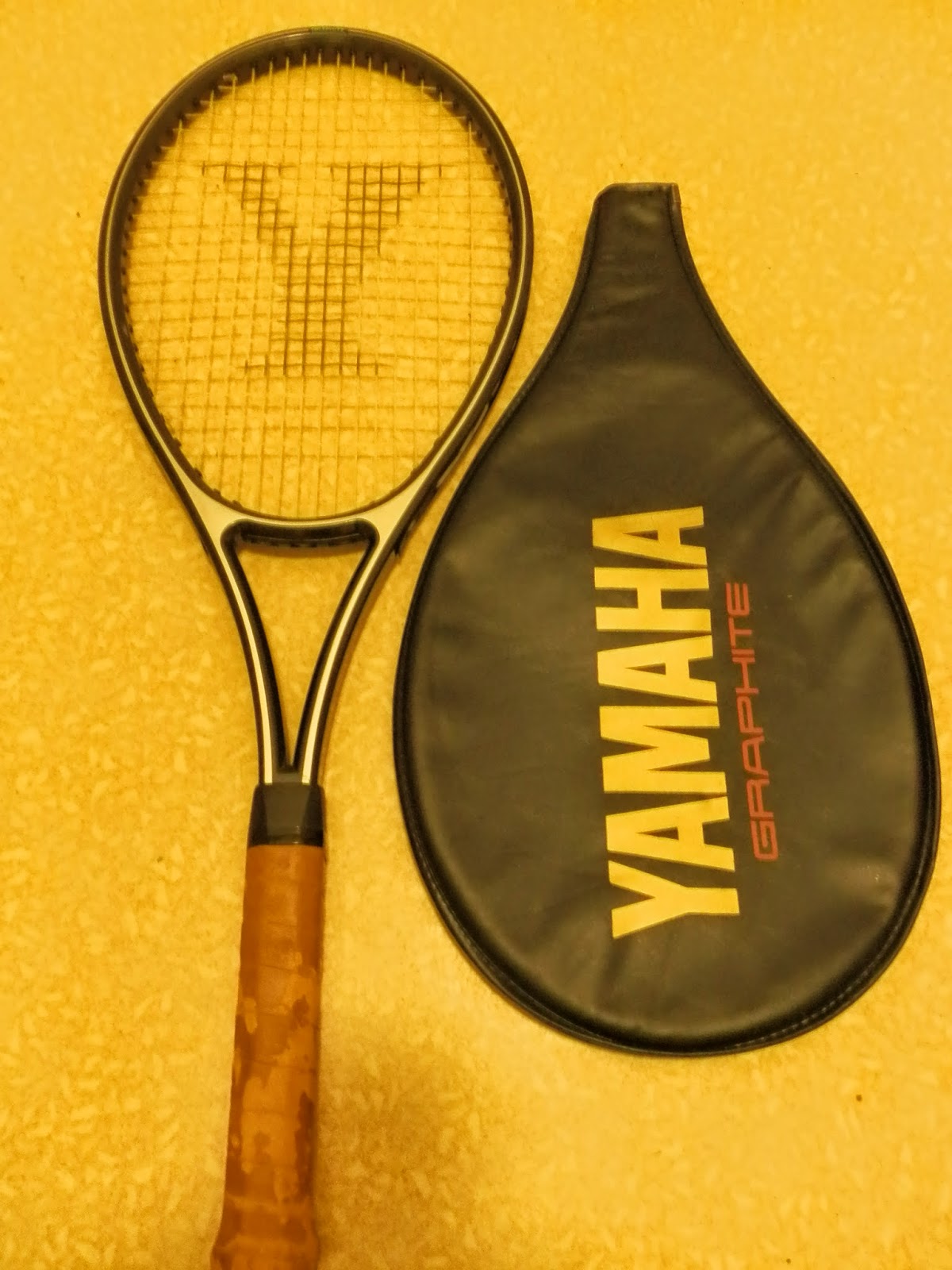
Yamaha Hi Flex Special

a little known classic - the Yamaha Hi Flex
This, in my view, is something of an undiscovered classic stick that I picked up from a recycling centre recently. From the lush padded case (these little things add to a racket too), to the neat silver finish, this racket just told me to buy it.  But the real clincher was the fact that I love flexible frames and the name of this racquet promised all the benefits of an arm-friendly experience with the wonderful hitting experience you can get from a frame that bends with the ball. Anyone who loves flexi frames knows what I am talking about - that sensation of bend and release that comes when you connect sweetly with a hit and also the sense of suspended time as the ball is held by the racket for a split second.  So, I was excited to try it, though not expecting too much since Yamaha are hardly a manufacturer people usually rave about.  But straight away this racquet gave me what I wanted.  It bends so sweetly when you strike the ball cleanly.
It has a 90 sq. inch head (approximately) but despite this the sweet spot seems generous.  The spin it gives me is considerable and this allows me to put more power into my shots without hitting long.  All in all a wonderful racket and one that is now right up there among my very favourite racquets. If anyone knows anything about the Yamaha Hi Flex range (I know there is a Hi Flex 3 and 9 respectively, for instance) then please leave a comment.

Sunday, 10 August 2014

Pro Staff 6.1 Classic (Tour Edition)

Having used the original Pro Staff (110 sq. inch) I decided to splash out and buy the 6.1 stick.  Not quite sure what I expected but I was immediately disappointed.  Maybe it was the string tension or maybe the grip size (L5) that meant this racket never quite worked for me.  It also did not have the same heavy dependable feel of my other beloved Pro Staff.  The feel of this racket was predictably stiff as you would expect from a Pro Staff but with a smaller sweet spot too I never warmed to it.  However, the paint job is lovely.  With a 95 sq. inch head and a stiffness rating of 72 you will need a swift swing speed to get the most from this frame.

Wilson T2000

The racquet made famous by the great Jimmy Connors.  The Wilson T2000 is one of the most recognizable racquets of all-time.  Its appearance marked the transition away from wooden frames and marked the dawn of a new era in tennis that ultimately lead towards graphite frames.  These frames are steel in construction and are incredibly heavy - no wonder Jimmy played with two hands!!
The stringing is also interesting, with the strings attached to the frame by wire grommets.  I have never really used these.  The heads are incredibly small - much less than 90 sq. inches (possibly 63 sq. inches ).  To use one you would need to be extremely accurate and have great technique. But they offer a fascinating glimpse into the tennis history.

Wilon Pro Staff 110 (large head version)

One of my all time favourite sticks - the Chicago made Pro Staff.  This large headed version is great for me because it combines a large hitting area with superb plow through to put real weight on the ball.  It is one of the very few vintage racquets that can still hold its own against modern sticks.  However, it is heavy for serving and hard to create whip, so you need a strong wrist for this. But it is amazingly stable and great at the net for volleying.  All in all one of the best racquets ever made in my view. 

Snauwaert Ergonom

This stick has to be one of the most eccentric ever made.  The idea was to improve the hitting area for forehands and backhands by changing the angle of the head by 45 degrees or so.  However, when serving they feel very strange and the position of the head gets some getting used to.  Maybe this is why they are something of a 'one hit wonder' - most people try them out to satisfy their curiosity and then put them away again.  Not sure if they are easy to restring on modern machines either, so another reason not to risk using them too much.  Again, found this one in a charity shop and mighty surprised I was to see it too!